Taste, from the dissertation on.
The dissertation.
Computing Point-of-View: Modeling and Simulating Judgments of Taste, 163 pages, for the Ph.D. in Media Arts and Sciences at MIT. Pattie Maes advised it. It asked whether a machine could recover not only a person’s ratings, but the point of view that produced them.
The papers around it.
What Would They Think? (IUI 2004) turned a person’s writing into guesses about how they might react to something new. InterestMap (2005) and Unraveling the Taste Fabric of Social Networks (2006) mapped cultural taste from the books, music, films and foods people name in public profiles. Social Network Profiles as Taste Performances (2007) read a profile as a public composition of self, made from what a person loves.
Taste, taught.
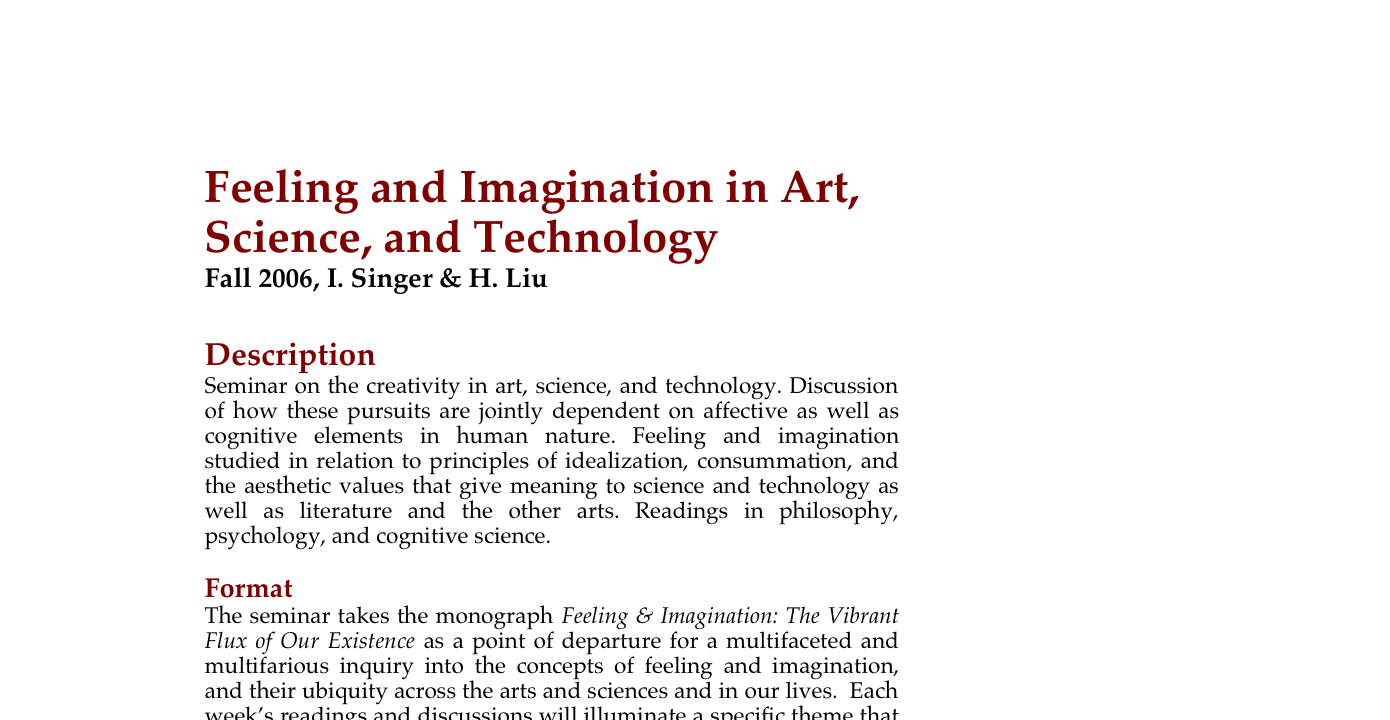
In the fall of 2006, the year I finished the doctorate, I co-taught Feeling and Imagination in Art, Science & Technology (24.262) at MIT with the philosopher Irving Singer.
Taste, as a product.
I built Hunch with Chris Dixon and Caterina Fake, as its Chief Scientist. Hunch took the taste research into a consumer product: answer a small set of questions and it learned a portable profile of what you might prefer across very different domains. eBay acquired Hunch in 2011.
Taste and art.
I presented Computing Taste at the Museum of Modern Art’s R&D Salon 15 on 29 April 2015. I built ArtAdvisor with Lucas Zwirner; Artsy acquired it in 2017, and I spent four years there as Chief Scientist, working where taste, culture and art meet.