


Caveat lector — this site is being built at unreasonable speed with a guild of magic elves. If something reads not quite right, someone might have gotten carried away. Please tell me so I can fix it. — Aguas Infinitas, Star
press & features

In the press.

Clippings from 2004 to 2023: natural-language programming, computational taste and affect, Hunch, art, and one very wet Burning Man. The strongest surviving record leads; where an original article has been preserved, it is linked.

selected outlets
The New York Times
Los Angeles Times
The Economist
The Boston Globe
WIRED
Fast Company
The Art Newspaper
MITTechnology Review

The clippings.

Each note says what the piece covered. Exact quotations remain in quotation marks.

WIRED2017
2017WIRED

Inside Artsy’s Quest to Make You Love Art as Much as Music

“It’s more than just auction results and prices, there’s a ton of rich cultural signals.”

WIRED followed ArtAdvisor into Artsy and made the distinction that mattered. Artsy’s Art Genome described traits of artworks and powered recommendations; the art brain I had built sought a wider account of cultural significance and value. At Artsy, institutional, gallery, browsing, buying, and market evidence could meet—without pretending that art had become certain.
Fast Company2017
2017Fast Company

How a Bunch of Data Geeks Charmed the Art World—and Modernized It

A broad account of Artsy’s attempt to make the art world legible through data. Carter Cleveland describes why the ArtAdvisor acquisition mattered: recommendation could say what someone might like, while my work tried to model the larger cultural context behind why an artist or work becomes valuable.

The Art Newspaper2017
2017The Art Newspaper

Artsy and the Rise of the Matchmaker Market

The trade paper placed the work inside the art market itself. It identified me as Artsy’s first Chief Scientist and connected the earlier taste research, trend prediction, and artificial intelligence to Artsy’s effort to give collectors useful, personalized intelligence.

Invaluable2016
2016Invaluable

How Data Will Disrupt the Business of Art

Before the Artsy acquisition, this account gave ArtAdvisor a substantial section of its own. The premise was not that data should replace expert intuition; it was that large cultural datasets could help expose some of the evidence and learned judgments from which expert intuition is made.

The New York Times Magazine
2005The New York Times Magazine · The Year in Ideas

The Synesthetic Cookbook

“Synesthetic Recipes, a searchable computer database of 60,000 recipes”

The Magazine’s 2005 Year in Ideas selected the Synesthetic Cookbook: a “smart” cookbook that searched existing recipes by sensation and emotion as well as ingredient and method. Its deliberately unruly example asks for a dish that is sweet, salty, sour, meaty, dessert-like, primal, and sophisticated; the database answers with Brunswick stew.

The Improper BostonianBoston’s Most Eligible · 2012
2012The Improper Bostonian · Singular Sensations

Singular Sensations

The magazine’s annual portrait of twenty accomplished single Bostonians profiled Hugo first: then chief scientist at Hunch and a taste researcher at MIT, working where technology met style and taste. The profile moves from emotional recipe search and custom Scotch blended for Proustian memory to Coco Chanel as favorite philosopher. It closes: “A guy to watch, whether you want tips on couture or the hottest IPO.”

The New York Times
2023The New York Times · front page

Muck, Danger And Partying In the Desert

“Burning Man is an all-weather state of mind.”

The Times’s September 4 front page reported from a flooded playa, where thousands were stranded and asked to conserve food and water. In the opening column, Star declined the language of helplessness: “When it’s time to leave, we’ll leave. Burners aren’t victims.”

Los Angeles Times
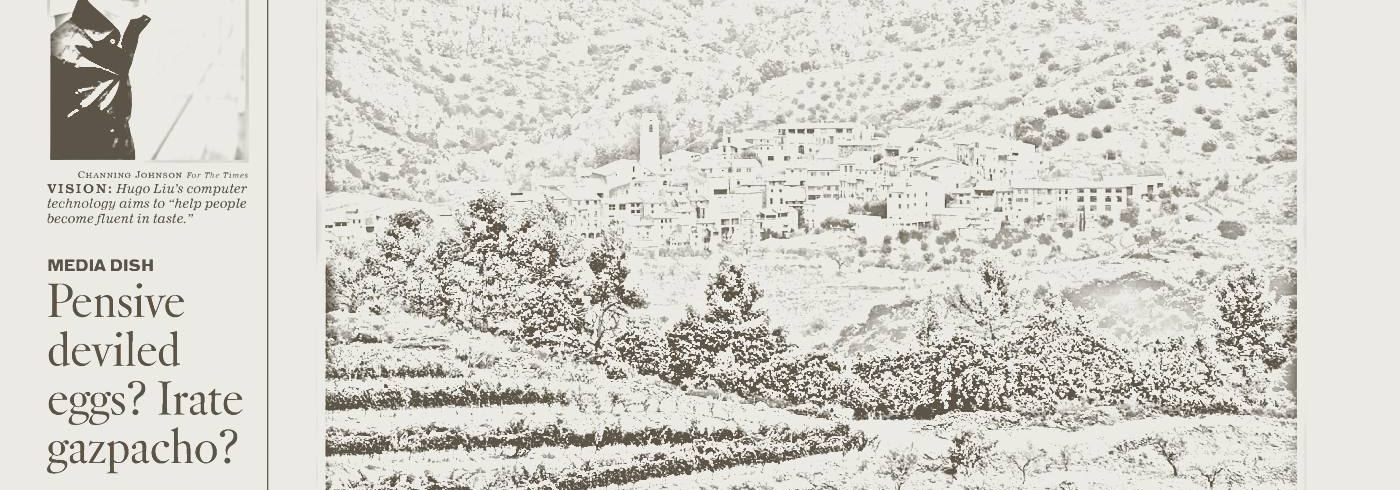
The Food section front of August 15, 2007 — an impression of the page itself
2007Los Angeles Times · Food

Pensive deviled eggs? Irate gazpacho?

“Hugo was like a wet finger in an electric socket.”

A full Food-section portrait of the attempt to “help people become fluent in taste.” It follows Taste Spaces, the Synesthetic Cookbook’s analysis of 160,000 recipes, and Gulp Fiction’s attempt to compose new ones from learned patterns. The reporter preserves the experiment’s limits too: generated directions could be lyrical and absurd, and the “kitchen chemistry” had not caught up with the computational imagination.

The EconomistPrint edition · 2015
2015The Economist Espresso

Shape of things to come: the Guggenheim game

The Economist introduced Åzone Futures Market, the Guggenheim’s first online exhibition and a forecasting game. Visitors received 10,000 units of Åzone currency to invest in possible technologies across the coming decades: lab-grown replacement limbs, laser-regenerated teeth, genome-edited plants. As the clipping put it, “the real action is online: place your bets.”

Fast Company2015
2015Fast Company

The Guggenheim Launches Its First Ever Online Exhibition

Fast Company named the people who made Åzone Futures Market, including me as the data scientist who built its market algorithm. The work was a web-based simulated market in possible technologies, with a public terminal at 181 Front Street in New York’s Seaport Culture District.

The Boston Globe
2008The Boston Globe

Tech’s Feminine Side — CV title

The surviving continuation page is headed “Gadgets finding their feminine side.” The broad feature on gender assumptions embedded in products included GenderLens, built from 150,000 blog entries. Its news-filtering experiment created men’s and women’s feeds; in four of five categories, they predicted which stories each group preferred. The article’s larger question was practical: what changes when an interface stops assuming one default kind of user?

San Jose Mercury News2009
2009San Jose Mercury News

New Q&A Web site personalizes answers.

Elise Ackerman’s feature introduced Hunch while it was still new: a question-and-answer site that learned a person through a short sequence of questions, then used those answers to personalize decisions in unrelated domains. The piece survives through its newspaper syndications.

Technology Research News2005
2005Technology Research News · Technology Review

Tool Turns English into Code Outline

Metafor treated an ordinary story as a partial program specification: nouns suggested objects, verbs suggested actions, and relations suggested structure. Technology Research News made it a cover story; Technology Review, MIT Technology Insider, IEEE Software, Optimize, Slashdot, and ACM TechNews also followed the experiment.

MITTechnology Review
2004–05MIT Technology Insider · Technology Review

Digital Serendipity

A ring or watch reads the tag on a physical object; Ambient Semantics consults InterestMap and sends a recommendation to the wearer’s phone. The 2004 report describes working wearable prototypes and a map of 50,000 items. Technology Review returned in 2005, by then describing two million relationships among 100,000 items—and a next step in which the same sensor could notice shared interests between strangers before the opportunity passed.

The Los Angeles Times feature was syndicated by The Baltimore Sun as “More than a dash of whimsy.” Swedish television interviews from the 2015 Webbdagarna visit are preserved with the recordings. Artsy’s acquisition announcement remains the primary institutional record of ArtAdvisor joining Artsy.

What they've said.

“…a particularly talented programmer/designer named Hugo Liu…”
Chris Dixon · writing about working with Hugo at Hunch, 2011
“My (awesome, brilliant) colleague at Hunch, Hugo Liu, has a piece in a Shanghainese journal, Cultural Review…”
Caterina Fake · introducing Hugo’s Cultural Review essay, 2009

Honors & recognition

research awards
2018Impact Award — ACM Intelligent User Interfaces, the test-of-time honor for the 2003 affect-sensing paper
2003Best Paper Award — ACM Intelligent User Interfaces (IUI), Miami
2002Best AI Paper Award — Int’l Conference on Adaptive Hypermedia, Málaga, awarded by the Asociación Española para la Inteligencia Artificial
recognition, fellowships & exhibitions
2005The Year in Ideas — The New York Times Magazine, for the Synesthetic Cookbook
2015“Åzone Futures Market” — Guggenheim web exhibition, with its public terminal at 181 Front Street, New York
2015“Architecture Personality Genome” & “Matchmaker Game” — Guggenheim Helsinki NOW, Kunsthalle Helsinki
2008Inclusion — Restaurant Business 50 Greatest Ideas
2006First Place Team — MIT Organic Marketing Competition
2005First Place — Snowflake-a-thon Programming Competition, MIT, for I Am a Beautiful Snowflake
2005AOL Fellowship (2005–06) · British Telecom Fellowship (2004–05), MIT Media Lab
invited stages
2015“Computing Taste” — R&D Salon, Museum of Modern Art, New York
2015Masterclass in Digital Architecture — Guggenheim Museum, New York
2012“Big Taste Data” — plenary, King Abdullah University of Science and Technology, Jeddah
2006“The Synesthetic Cookbook” — plenary, Taste3, Robert Mondavi’s 40th, Napa
2005“Representing Point-of-View in AI” — keynote, Portuguese Conference on AI (EPIA)
appointments
2017Advisor, Global Innovation Group — Guggenheim Museum
2017Steering Committee — UNESCO Chair in Gender Equality & Empowerment, Amrita University
← back home